
CHAPTER 15 · FMC / TFM / PCI Level 2
Acquisition, Reporting and Data Governance
In this chapter · 15 sections
Purpose
A field examination is successful only if another authorised reviewer can establish what was examined, how data were acquired, how reported images were reconstructed and which evidence supported the result. A screenshot and a setup filename do not provide that chain. FMC can generate thousands of elementary A-scans at every position, and TFM/PCI can generate many derived views. Data volume makes governance more important, not less.
This chapter brings technique control onto site. It covers readiness, scan execution, in-process quality, file identity, transfer, reproducible reconstruction and report structure. Observation, interpretation, sizing and acceptance remain distinct in the report. Corrections after issue must preserve the original record and follow the authorised amendment process.
Learning outcomes
After completing this chapter, the learner will be able to:
execute pre-scan, in-scan and post-scan checks under a controlled instruction;
maintain coupling, encoder, coverage and file-integrity evidence;
record the acquisition and processing information needed to reproduce a result;
separate observation, interpretation, sizing and acceptance in a report;
preserve raw data, derived products, revisions and software identity; and
recognise when rescanning, controlled reprocessing, amended reporting or escalation is required.
Crossover map: from encoded PAUT record to reproducible dataset
| Familiar field control | FMC/TFM/PCI requirement | Failure prevented |
|---|---|---|
| Mark datum, scan direction and weld ID. | Link component coordinates, encoder origin, dataset and indication IDs. | Mirrored, shifted or wrong-component results. |
| Save setup and scan file. | Retain acquisition setup, raw pair data, reconstruction recipe and implementation version. | Images that cannot be reproduced. |
| Monitor coupling and encoded coverage. | Preserve independent coupling/channel/position evidence across large matrix datasets. | Silent gaps hidden by attractive reconstruction. |
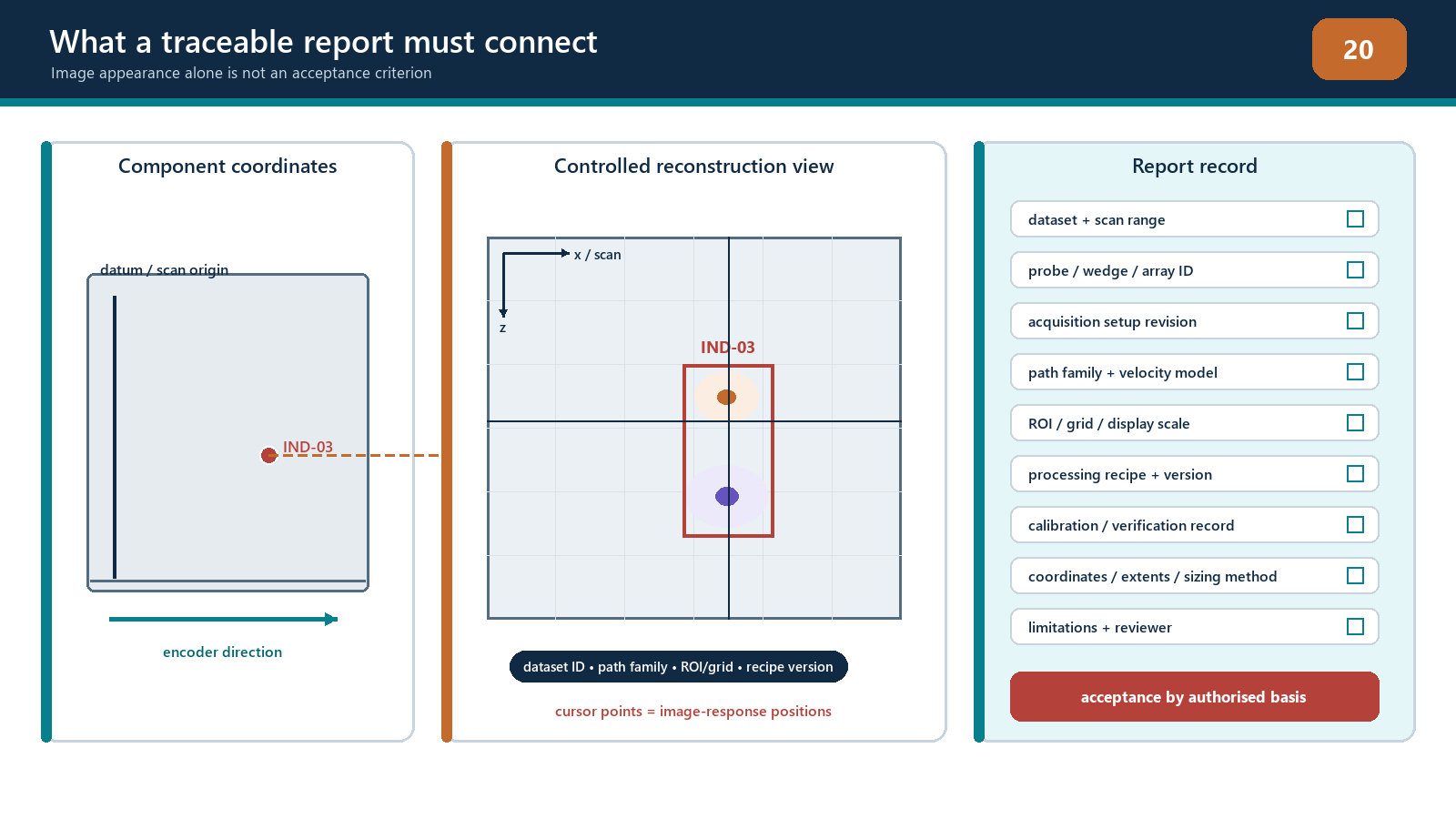
| Capture indication screenshots. | Link each reported view to source frame, path, ROI/grid, scale and processing revision. | Orphan images without provenance. |
| Issue and revise a report. | Preserve original, review history, amendment reason and affected data products. | Undocumented reinterpretation or overwritten evidence. |
Site readiness and pre-scan controls
Before coupling the probe, confirm the released instruction, component identity, material/thickness range, scan surfaces, extent, datum and acceptance source. Inspect surface condition, temperature, access, coatings and physical obstructions. Mark the scan origin and positive direction so that the mark can be verified independently of the display.
Confirm equipment, probe, wedge, scanner, cable and software identifiers against the controlled technique. Check available storage, power, file path and clock where timestamps are part of traceability. A nearly full disk that stops halfway through an FMC line is not a subtle technical limitation; it is preventable preparation failure.
Complete the required equipment, setup and performance checks. Load the released acquisition and reconstruction revisions and verify that the displayed file names are not merely familiar. Compare key essential variables with the instruction rather than assuming that “latest” means approved.
File and scan identity
Use a naming scheme that remains unique after files leave the instrument. Include or link:
project/job and component identifier;
weld, seam or examination area;
scan side/surface and pass number;
datum and direction;
acquisition date/time or sequence identifier;
setup/revision identifier; and
operator or instrument record where required.
Avoid relying on folder location alone. A copied file named Scan1 can become detached from its original folder. The authoritative register should link the raw file, setup, component, coordinate range and integrity information such as size or checksum where controlled by the organisation.
Never overwrite a production raw dataset with reprocessed data. Derived images, exports and reports should carry their own revision and retain a link to the source acquisition.
In-scan quality control
Monitor controls that indicate whether valid positions and waveforms are being collected:
coupling or a representative backwall/interface channel;
element/channel status and unexpected noise;
encoder position, direction and continuity;
scan speed and acquisition-rate margin;
saturation/clipping and useful signal level;
probe contact, skew and scanner tracking;
required overlap and physical scan limits;
file growth, dropped-data indicators and storage; and
environmental variables within the qualified range.
Where PCI suppresses broad interface responses, do not use its clean background as coupling evidence. Maintain a parallel signal with known coupling behaviour. If coupling is lost, pause at a traceable position, correct the cause and repeat the affected segment with the overlap required by the instruction.
At the end of each line or pass, compare stored start/end positions with physical marks. Review the encoded map for gaps, repeated coordinates or discontinuities. Conduct a prompt spot review of required path views so that an acquisition defect is found before the scanner and access are removed.
Post-scan checks and transfer
Complete the defined post-use verification before releasing the component or dismantling the setup. If it fails, quarantine data back to the last valid check and follow the approved disposition.
During transfer:
copy the raw dataset without changing it;
copy the acquisition setup and required calibration/reference data;
preserve encoder/auxiliary channels and metadata;
verify file count, size and integrity using the controlled method;
record source and destination locations;
restrict write access to the preserved original; and
perform review/reconstruction on a controlled working copy.
Exported images or PDFs are derived products. They can support reporting but cannot replace raw data when the procedure requires reproducibility or later reprocessing.
Reconstruction recipe and provenance
A reproducible reconstruction record includes:
source dataset and encoded position range;
instrument, firmware/software and algorithm version;
probe/wedge and active element map;
acquisition matrix, sample rate, range, gain and filters;
material velocity, thickness and surface/wedge model;
path family and transmit/receive aperture or pair set;
ROI coordinates and grid;
interpolation, envelope, weighting and normalisation where available;
phase/coherence implementation and its controllable settings;
display range, threshold and colour scale used for the reported image; and
recipe author, reviewer, revision and date.
If the acquisition irreversibly discarded amplitude—for example, a documented single-bit phase-only route—state that limitation. It cannot later produce conventional amplitude TFM unless a separate full-waveform acquisition was retained.
Report structure
Examination identity and scope
Identify component, area, datum, surfaces, scan extent, method/technique revision, equipment and personnel authorisation. State unexamined or limited areas plainly.
Observation
Record the indication ID, coordinates, scan range, path/view and image domain. Describe what was observed without inserting unsupported flaw type or acceptance language.
Interpretation and characterisation
State the evidence supporting relevance, geometry exclusion and any characterisation. Link annotated fixed-scale images and representative raw data. Record credible unresolved alternatives.
Sizing
State the authorised method, measured dimensions, coordinate convention, repeated result and uncertainty/limitation. Separate image-response endpoints from physical flaw endpoints unless the technique validates that relationship.
Evaluation and disposition
Identify the acceptance source and who made the decision. If the examiner is not authorised to accept/reject, report the technical result and route it for evaluation. Do not let a report template silently assign authority.
Traceability and limitations
List source dataset, setup and recipe revisions, calibration/verification record and software version. State coverage gaps, sensitivity limits, material issues, ambiguous evidence and any departure processed under the approved system.
Reprocessing, rescanning and report amendment
Reprocessing from retained raw data may be appropriate when a controlled recipe changes without invalidating acquisition. Record the reason, authority, old and new revisions, affected indications and review result. Do not delete the earlier derived image.
Rescanning is required when acquisition evidence is missing or invalid: lost coupling, clipping, incomplete time range, encoder gaps, wrong physical position, unavailable channels beyond limits or a failed post-use check without acceptable disposition.
An amended report must identify the superseded report, reason for change, changed fields, supporting evidence, reviewer/approver and distribution. Quietly replacing a PDF or database value destroys the review chain.
Data correction is not the same as technical reinterpretation. Correcting a typographical component ID may follow one route; changing indication height or acceptance disposition requires technical review and possibly client/project notification under the controlled system.
Data retention, access and integrity
Follow the project and organisation retention schedule. Retain raw or losslessly recoverable data and metadata sufficient to reproduce the report where required. Preserve calibration/reference records, technique revisions, derived images, worksheets, report and amendment history.
Use role-based access so preserved originals cannot be casually overwritten. Record migrations or conversions. If a proprietary format depends on particular software, retain the reader/version or an approved export that preserves required evidence. Periodically verify that archived data remain readable. A perfectly controlled file that no authorised system can open is merely well-documented archaeology.
Field workflow: acquire to report
Verify site, component, instruction, equipment and approval status.
Mark datum/direction and complete pre-scan checks.
Start uniquely identified files and confirm essential variables.
Acquire while monitoring coupling, channels, position, rate and storage.
Repeat affected sections immediately when controlled quality criteria fail.
Complete post-scan checks and quarantine data if required.
Transfer and integrity-check raw data, setups and reference records.
Reconstruct on a controlled copy using an identified recipe.
Prepare indication evidence and report each decision layer separately.
Review, approve, distribute and archive according to the controlled workflow.
Practical 15 — Field-style examination and peer audit
Aim
Execute an encoded examination from a controlled instruction, transfer the data, reproduce a reported view and audit the complete record.
Resources
representative component or validated training specimen;
approved training instruction and acceptance-source extract;
identified array system, scanner and storage media/location;
reference/performance specimen and check records;
separate review station where available; and
field worksheet, indication table and report template.
Method
Conduct a site and component readiness review.
Mark datum, scan origin, direction and required extent.
Verify equipment/setup and complete reference checks.
Create uniquely identified scan files and confirm storage capacity.
Acquire all required passes while recording coupling, position and deviations.
Complete post-scan checks and compare physical/stored extents.
Transfer data and verify integrity under the controlled method.
Reproduce one selected image on a separate station using the recorded recipe.
Prepare an indication entry with source links, sizing basis and limitations.
Exchange the package with another learner and perform a traceability audit.
Correct identified record defects through a revision—not by overwriting evidence.
Submit the final package for instructor review.
Evidence to retain
readiness and pre/post check records;
datum/coverage photographs or controlled sketches;
raw dataset, setup and auxiliary channels;
file transfer/integrity record;
reconstruction recipe and reproduction comparison;
indication table, images and sizing worksheets;
peer-audit checklist and revision history; and
final report with approval status.
Stop rules
Stop if component identity/datum is uncertain; the instruction is not released; essential variables do not match; coupling or channel/encoder evidence fails; storage or file identity is unreliable; post-use checks fail; raw data are unavailable after transfer; the image cannot be reproduced; or report acceptance is being assigned by an unauthorised person. Secure the data and escalate before access disappears.
Common traps
Naming production files Scan1, Final or Final2 without a register.
Treating a screenshot as the raw record.
Using PCI background appearance as coupling proof.
Failing to compare stored coordinates with physical marks.
Reconstructing on the preserved original file.
Omitting algorithm/software version from the recipe.
Independently normalising report images without disclosure.
Mixing observation, characterisation and acceptance in one sentence.
Replacing a report rather than issuing a controlled amendment.
Archiving data without proving it can be read later.
Chapter summary
Controlled field application links component identity, datum, setup, raw acquisition, reconstruction recipe, interpretation and report. Pre-, in- and post-scan evidence must show coupling, channels, encoded position, coverage and file integrity. Raw data and derived images are different records; neither should be overwritten.
A defensible report separates observation, interpretation, sizing and acceptance, names the source dataset and recipe, and states limitations. Reprocessing, rescanning and amendment follow different routes. Governance may feel less exciting than a new image mode, but it is what lets the result survive after the probe, instrument and operator have left site.
Study and revision only. This is not an approved inspection procedure, acceptance criterion or qualification.