
CHAPTER 26 · Ultrasonics Level 3
Standards, Governance and Level 3 Decision Cases
In this chapter · 27 sections
Why this matters
A Level 2 technician can follow an approved procedure and identify the document used; the Level 3 problem appears when a contract, client specification, standard, engineering drawing, procedure and task instruction use different words, editions or ranges. One question concerns authority: which requirement governs the project. A second concerns capability: what physical consequence follows for the ultrasonic result. Good governance keeps those questions connected without allowing a newer document to replace the contract silently or a compliant setting to substitute for demonstrated performance.
What you already need
- The distinction between technical capability and acceptance evaluation.
- Essential-variable, change-impact and evidence concepts from Chapter 18.
- The qualification, reliability and applicability-domain concepts from Chapters 22 and 23.
- The data provenance and software-identity concepts from Chapter 21.
- Familiarity with procedures, instructions, reports and reference checks.
What you will learn
- Read a project-specific document hierarchy without inventing a universal order.
- Separate requirement authority from ultrasonic capability.
- Review a technique by tracing claims to evidence and settings to consequences.
- Classify hardware, software and document changes by affected output.
- Preserve digital configuration and record meaning through time.
- Resolve common Level 3 cases with proportionate, traceable decisions.
Words you will meet
- Contractual hierarchy: project-specific order of authority among invoked documents.
- Normative reference: document incorporated as a requirement by another document.
- Configuration baseline: identified system state to which evidence applies.
- Change control: traceable review of a proposed or completed change.
- Technical authority: assigned power to approve or disposition a technical matter.
- Competence: knowledge, skill, experience and recognition of limits for a task.
- Independent review: challenge performed with freedom to reach another conclusion.
- Data integrity: preservation of complete and unaltered data within stated controls.
- Record identity: information linking evidence to component, system and decision.
- Amendment: traceable addition or correction that preserves earlier record history.
Depth guide for this chapter
- Understand here: document authority, technical review, configuration, change and ethical communication.
- Calculate here: task-linked comparisons used inside the decision cases.
- Derive later: software architecture, digital identity and algorithm-validation depth continue in Chapters 69, 72 and 80.
26.1 Begin with the familiar document conflict
Assume a project contract cites one edition of an application standard; a client specification adds reporting fields. An approved procedure cites an older edition, while a task instruction lists the component, equipment and scan positions. A newer edition of the standard has since been published. The newer edition does not become governing merely because it is newer; the approved procedure does not overrule the contract merely because it is closer to the task. The conflict must be resolved through the project’s authority chain, and the physical evidence supporting the technique is then reviewed for any technical difference created by that resolution.
Public scope information for International Organization for Standardization (ISO) 16810:2024 describes general ultrasonic principles and does not provide scan extent or acceptance criteria for every application. [R041] Application documents, specifications and contracts supply other layers. A study book can teach their relationship, but the authorised editions remain the source of project requirements.
26.2 A visual hierarchy without a false universal rule
The working hierarchy can be pictured from broad obligation to local execution: contract or regulation -> project or client specification -> invoked standard or code -> approved procedure -> task-specific instruction -> examination record and report
This sequence is illustrative; actual priority comes from the contract and incorporated references. A regulation can sit above the contract in one jurisdiction, while a project specification can expressly modify an application standard. A dated reference can remain controlling after a later edition appears. Each document does a different job; a contract establishes obligations. A specification adds project conditions, while a standard or code organises technical requirements within its scope. A procedure controls a method for a defined application range. A task instruction identifies the component, equipment, coordinates and task details. Records show what actually occurred.
The following figure joins that requirement hierarchy with physical models and evidence; notice that governing documents define required outcomes while physics and qualification establish capability.
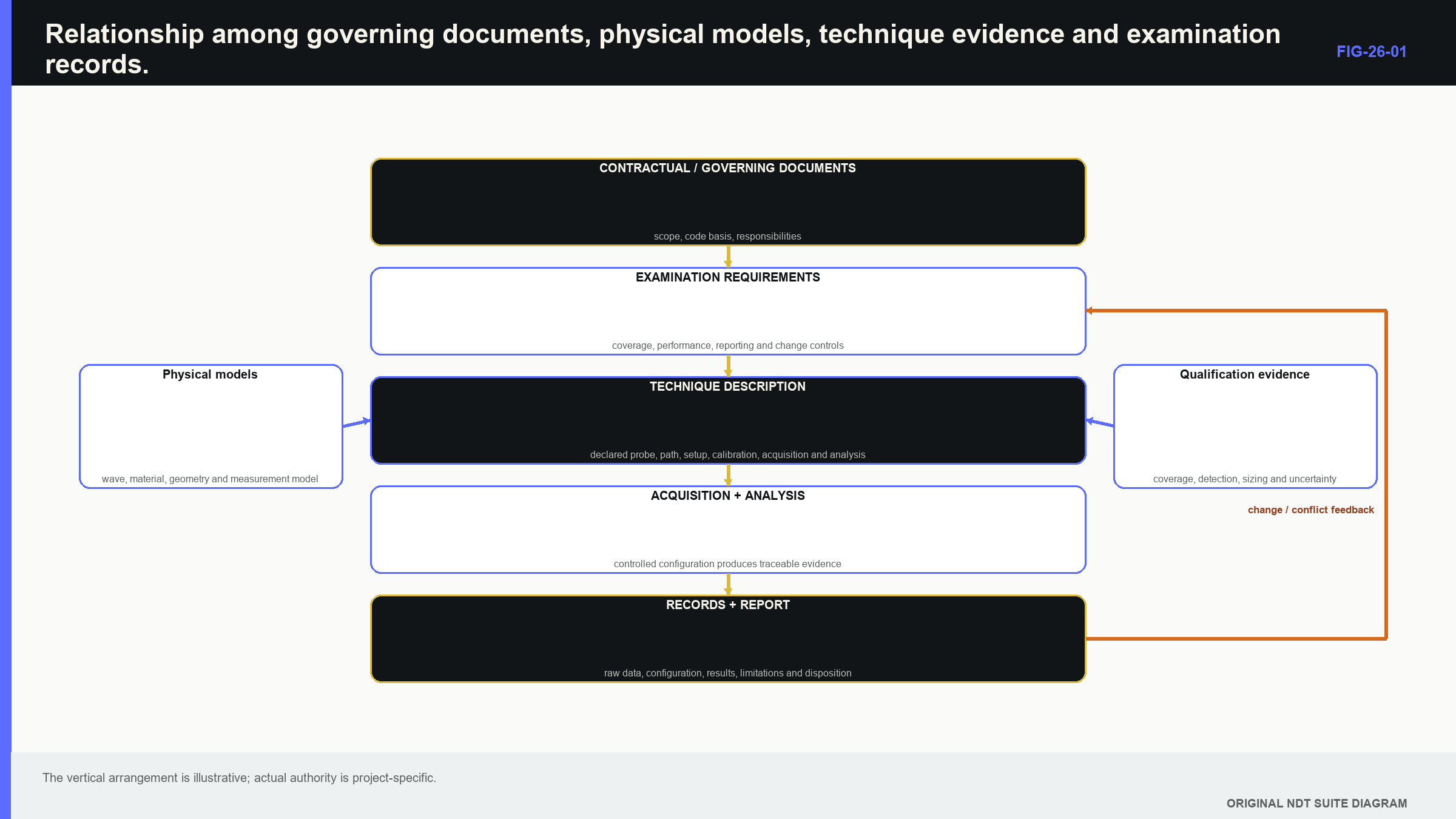
Document identity needs number, edition or date, amendment state and relevant scope; titles alone are weak because standards change. Public certification syllabi can cross-check study coverage, including arrays and modelling, but they do not define project acceptance or grant unlimited task authority. [R060]
26.3 Read language inside its defined scope
Technical documents use words such as shall, should, may, indication, imperfection, flaw and defect with controlled or contextual meanings; a reviewer should not silently substitute ordinary conversation meanings. An indication is observed evidence; a discontinuity is a physical interruption or material change. A defect may be a discontinuity that exceeds a specified acceptance rule. Treating every indication as a defect skips characterisation, sizing and evaluation.
Scope matters as much as terminology; a general-principles document can describe refraction and calibration while leaving scan extent to an application standard. A construction code can define acceptance for one component family without becoming a universal physical definition. Quoting a valid sentence outside its scope can create an invalid requirement. The public scope of the general-principles standard provides a concrete example of this boundary between common method concepts and application-specific coverage or acceptance. [R041]
Normative references create dependency; dated and undated references may behave differently under the governing document. Because authorised standards are controlled sources, procedures should identify them precisely instead of reproducing fragments from memory. Stable physics explanation and changing contractual rule should remain separate.
26.4 Procedures and instructions as declared models
A procedure is not only a sequence of actions; it declares a measurement model through component scope, equipment, variable ranges, reference basis, scan coverage, processing, interpretation and records. A task instruction translates that framework to one identifiable component and configuration. Strong writing distinguishes mandatory requirement from explanatory rationale; it uses observable outcomes rather than vague directions such as “scan adequately.” Coordinates have origins and axes, while reference sensitivity has a named artefact and response. Coverage has a region and field basis. Records have identities.
This book remains a study book, not a project operating instruction; the educational purpose is to show how a Level 3 reviewer tests completeness and causality. Actual work follows authorised project documents and roles.
26.5 Technical review in two directions
A strong review traces claims backward to evidence; a volumetric-coverage claim should lead to geometry, access and field support. A sizing claim should lead to signal identity, method, bias, uncertainty and representative results. A substitution allowance should lead to task-linked comparability outputs. A standards statement should lead to the correct edition and scope. The review also traces settings forward to consequences; frequency changes wavelength, penetration and resolution. A wedge change can alter delay, index, angle and field. A filter change can alter amplitude and timing. A software version can alter processing and coordinate representation.
Checklists prevent recurring omissions; they cannot determine whether a nominal 45-degree beam covers a curved fusion face or whether isotropic velocity represents an austenitic path. Independent reasoning remains necessary. Foundational physics such as that in the NASA ultrasonic tutorial supports stable concepts [R002], while application sufficiency remains part of the specific evidence argument.
26.6 Decision tree A: a failed end check
Situation: A reference response is 2.5 dB lower after four hours of scanning. Time base and index are unchanged. Cleaning and re-coupling the reference surface restores the response.
The decision tree is: preserve anomalous state -> compare electrical and acoustic references -> identify likely coupling cause -> examine production coupling evidence and time sequence -> bound affected output -> retain, repeat or limit data
Recovery after re-coupling supports an interface cause during the end check; it does not prove when production coupling changed. Stored back-wall trends, coupling indicators, signal-to-noise and scan sequence become important. If production data show stable response margin, some or all can remain technically usable; if an amplitude-based evaluation depended closely on the reference and no stability evidence exists, affected data may need reacquisition. Automatic disposal and automatic acceptance both skip the causal review.
26.7 Decision tree B: incomplete casting penetration
Situation: A lower-frequency probe produces a stable far-surface response across 70% of a casting. The remaining region has high structural noise and no stable deep reference. No discrete indication is resolved there.
The decision tree is: map interpretable region -> test representative depth response -> challenge unsupported region with frequency, mode, surface or method -> update capability map -> report limitation for engineering disposition
The supported 70% and unresolved 30% must remain separate. “No indications” in the noisy region does not establish soundness; the unresolved part may require another field, another surface, a representative target, a complementary method or an explicit incomplete-examination disposition. This case demonstrates that coverage includes acoustic capability, not only probe travel; chapter 24 supplied the physical diagnosis; governance preserves its honest boundary.
26.8 Decision tree C: conflicting methods
Situation: A phased-array pulse-echo view shows a strong directional face response over 24 mm. A complementary time-based view resolves extremities over 17 mm and estimates 5 mm height. Coordinates align within stated uncertainty.
The decision tree is: align coordinates and dimension definitions -> identify physical feature measured by each method -> compare resolution and blind zones -> preserve agreement and contradiction -> report supported model and alternatives
The two lengths can describe illuminated face extent and resolved extremity interval; selecting the larger number as automatically conservative ignores the structural dimension and the physics. Review beam footprint, thresholds, tip identity and endpoints. The result can report both observations and a bounded feature model; method disagreement becomes evidence when its physical cause is understood.
26.9 Decision tree D: an obsolete reference
Situation: A procedure cites an older standard edition while the contract invokes a newer one. Existing technique-performance evidence remains technically strong.
The decision tree is: establish contractual hierarchy -> compare changed requirements -> identify affected technical claims -> revise documents and bridge evidence proportionately -> record the resolution and authority
The newer edition does not silently invalidate physical evidence; it can change compliance, terminology, variable ranges or documentation. Some changes require only controlled document revision. Others affect the technique and need targeted evidence. No change is assumed until the editions are compared through authorised access. Requirements authority and physical capability are linked questions with different answers; the final record names the documents, relevant differences, decision owner and technical impact.
26.10 Configuration identity
A configuration baseline is the identified state for which evidence applies; it can include instrument and firmware, probe and wedge serials, cable, scanner, setup values, focal-law or processing file, reference artefacts and coordinate model. The concept is expressed compactly below.
| (26.1) Configuration identity concept · EQ-26-01 Where: each term denotes an identified, versioned part of the measurement state Model limits: conceptual relationship for traceability; not a numerical equation |
|---|
The relationship supports traceability rather than calculation; some items influence acoustic physics directly. Others preserve the meaning of data. Both can be essential. A hash shows whether a file changed; it does not show that the file is correct. A digital signature can authenticate origin without validating technique performance. A version number identifies a release without describing every implementation option. These controls become useful when linked to physical and software evidence.
Derived data should retain parent identity and processing history; a newly reconstructed image is a new measurement result from retained observations. It should not overwrite the original. Digital reference datasets challenge software behaviour, while physical blocks challenge the acoustic chain. Neither replaces the other.
26.11 Change classification by affected claim
The label minor change is meaningful only after impact analysis; correcting a spelling error may leave every technical claim unchanged. Changing a colour map can affect human recognition while preserving numeric samples. Changing a filter can affect amplitude, timing and separation. Changing a wedge can affect coverage and location.
| Worked example · Classifying a proposed probe change WE-26-01 Given: A replacement probe has the same nominal frequency and diameter. Measured zero differs by 0.8 microseconds, -6 dB bandwidth differs by 15%, and -6 dB beam width at target depth differs by 20%. Find: The claims needing renewed evidence. Steps: Map zero to location. Map bandwidth to pulse duration and resolution. Map beam width to coverage and any beam-based amplitude sizing. Answer: A stable time correction can address zero, but resolution, coverage and beam-based sizing require comparison. Nominal identity alone is insufficient. Technical implication: Targeted re-evidence follows the changed outputs. Unrelated evidence can remain when configuration and causality show it is unaffected. Common mistake: Treating a successful reference calibration as proof that field width and resolution are unchanged. |
|---|
Evidence can often be bridged; equivalent timing, amplitude, bandwidth and data behaviour across the relevant domain can preserve earlier application demonstrations. A difference confined to an unused function may not affect the claim. A difference in coverage or discrimination requires application evidence to be revisited.
26.12 Technical decision case: a processing update
| Worked example · Tracing the impact of a processing-version change WE-26-02 Given: A software update leaves raw RF samples and metadata unchanged but changes envelope smoothing from a 5-sample to a 13-sample window. Detection uses envelope peak above threshold. Tip location uses envelope peak time. Find: The claims requiring comparison. Steps: Longer smoothing can change peak amplitude, merge nearby peaks and shift peak time. Link those effects to detection threshold, temporal resolution and location. Confirm that field, raw acquisition and coordinates are unchanged independently. Answer: Representative threshold-region detection, close-signal resolution and timing comparisons are required. Probe field and acoustic coverage evidence can remain relevant when raw acquisition is demonstrably unchanged. Technical implication: Preserved raw data limits the affected boundary but does not make the processed measurement identical. Common mistake: Treating an unchanged menu name or sharper display as proof of numerical equivalence. |
|---|
If reprocessing creates a sharper image and changes indicated height, sharpness is not truth; compare algorithm definitions, point-spread response, validation data, tip identity and uncertainty. Preserve both outputs, their software versions and the decision basis. Chapter 69 treats processing-chain validation, Chapter 72 treats adaptive-image comparisons and Chapter 80 treats software verification and rollback.
26.13 Records that preserve technical meaning
A useful record identifies component, examined region, coordinate system, system configuration, reference state, processing, observations, conclusion and decision basis; a time needs zero and velocity conventions. An amplitude needs its reference and processing. An indication needs association evidence. Retention without readability is weak governance; proprietary formats can become inaccessible. Exports can lose metadata. A sustainable strategy preserves original data, a documented representation, configuration identity and enough human-readable context to recover essential quantities. Recovery tests are more useful than assuming a backup is healthy because its dashboard is cheerful. Archival gremlins tend to be extremely patient.
Corrections should be additive and traceable; replacing an original report erases decision history. An amendment identifies the change, reason, reviewer and effect on disposition. This preserves learning as well as accountability.
26.14 Competence, authority and independent challenge
Competence combines knowledge, practical skill, experience and recognition of limits for a task; certification provides structured evidence for a method and level. It does not create competence in every unusual material, simulation, fracture assessment or software system. Technical authority is organisational or contractual power to approve a matter; a person can understand the physics without holding disposition authority. An authorised approver can still require specialist input. Governance should align competence with authority and provide a route for escalation.
Independent review is strongest when the reviewer can inspect underlying evidence and record a different conclusion; independence does not require ignorance of context. It requires freedom from a predetermined answer. A junior analyst’s contradictory waveform deserves technical examination; a senior signature cannot repair a wrong coordinate model. Public syllabi help organise expected knowledge [R060], while task-specific competence and authority remain part of the organisation and contract.
26.15 Ethical communication and incomplete domains
Technical authority carries an obligation to state uncertainty, limitation and conflict at their true strength; pressure can encourage vague wording, suppressed contradictions or borrowed approval. Overcalling without evidence is not automatically safer. It can waste intervention resources, hide method bias and reduce trust. Consider a technique demonstrated on 20 mm to 40 mm fine-grained ferritic welds; a 32 mm component contains a local austenitic repair. Thickness lies inside the demonstrated range, but propagation material does not. Reference sensitivity in adjacent parent material cannot establish capability through the repair. The result can remain supported for parent-material paths and limited for the repair until representative evidence is developed.
Applicability is the intersection of influential domains, not a match to one convenient variable; honest incomplete evidence gives the engineering decision a real problem to manage. Confident wording cannot turn unsupported material into examined volume.
26.16 Governance as a living technical argument
Change control preserves why a configuration changed, which evidence was considered and which claims survived; it prevents an organisation from repeating old experiments or losing the reason behind a restriction. Governance is therefore accumulated technical knowledge, not paperwork added after the acoustics. Too little control turns a successful demonstration into an anecdote whose boundaries fade; excessive unstructured control freezes useful change without improving decisions. Proportionate governance keeps requirements, configuration, evidence and outputs linked through time.
Parts I to III have moved from observing an echo to defending a complete conventional-UT measurement system; later parts add phased arrays, full-matrix capture, total focusing and phase-coherence imaging. Their channel counts and processing increase, but the same chain remains: physical event, acquisition, transformation, interpretation and decision. More pixels give the gremlins sharper accommodation; they do not repeal causality.
In plain words
- The governing document hierarchy is project specific and must be traced through authorised references.
- Requirement authority and ultrasonic capability are linked but separate questions.
- Procedures and instructions declare technical models as well as task information.
- Review traces claims backward to evidence and settings forward to consequences.
- A configuration baseline identifies the system state supported by evidence.
- Change classification follows affected output, not labels such as minor or identical.
- Records preserve technical meaning only when data, coordinates, processing and decisions remain linked.
- Competence, authority and independent review must work together without hiding limitations.
Key terms
- Contractual hierarchy: project-specific authority among invoked documents.
- Configuration baseline: identified state to which evidence applies.
- Change control: review and recording of affected claims and evidence.
- Technical authority: assigned power to approve a technical decision.
- Competence: task-relevant knowledge, skill, experience and limits.
- Independent review: technically free challenge of evidence and reasoning.
- Data integrity: preservation of complete, unchanged and interpretable data.
- Amendment: traceable correction that preserves record history.
Key relationships
- authority question + capability question: compliance and physical adequacy require distinct answers.
- Configuration = hardware + software + setup + references + processing + coordinate model: evidence belongs to an identified system state.
- change -> affected claim -> surviving evidence -> targeted re-evidence: causal impact defines proportionate control.
- claim -> model -> evidence -> record: review traces the technical argument in both directions.
Common mix-ups
- The newest standard edition is not automatically the project’s governing edition.
- Compliance with an allowed setting does not prove technique capability.
- A file hash proves identity, not physical correctness.
- Certification is not universal task competence or disposition authority.
- A sharper reprocessed image is not automatically a truer measurement.
Bridge to Part IV
Part III closes the conventional-UT progression with a complete system and governance view; Part IV begins phased-array Level 2 from that familiar foundation. One probe element becomes many controlled elements, while the same requirements for paths, calibration, evidence, provenance and bounded interpretation remain.
Sources and further study
- [R002]
- [R041]
- [R060]
Study and revision only. This is not an approved inspection procedure, acceptance criterion or qualification.