
CHAPTER 63 · FMC / TFM / PCI Level 3
Advanced Interpretation, Governance and Level 3 Cases
In this chapter · 31 sections
Why this matters
Level 3 decisions often contain agreement and conflict at the same time. Several views may support a planar reflector while one validated view challenges the inferred height. A software update may move a coherence response. A reduced acquisition may miss a target class that a full matrix shows. The conclusion must state what the combined evidence supports, what remains uncertain and what change requires redesign or further demonstration.
Five cases drive this chapter. Geometry can appear coherent. Grid and interpolation can change an apparent size. Reduced acquisition can remove a target class. A software change can alter phase-derived contrast. Competing material models can place the same response differently. The detailed cases appear later; they provide the practical reason for introducing probabilistic language, data fusion, software declarations and change control.
What you already need
- Different views can share data and therefore are not automatically independent evidence.
- Sizing is a measurement with model and setup uncertainty.
- Software version and configuration can change a reconstructed output.
- A technical conclusion must stay within the demonstrated technique and population.
What you will learn
You will compare competing hypotheses without treating one image as proof; explain simple prior and likelihood ideas; combine dependent and conflicting evidence carefully; report uncertainty-aware size; define reproducible software and data records; assess change impact; and write a bounded Level 3 conclusion.
Words you will meet
A hypothesis is one possible physical explanation of the evidence. A prior describes the starting plausibility assigned before the new evidence is considered. A likelihood describes how compatible the observed evidence is with a hypothesis. Data fusion combines evidence under a declared dependence rule. Change control is the process used to assess, approve and record a change that may affect comparability or capability.
The Level 3 step
The chapter uses probability as disciplined language for evidence, not as a machine that produces certainty. A calculation is only as defensible as its hypotheses, data dependence and validation. The final handover must let an independent reviewer reproduce the result and see where technical authority ends.
63.1 Multi-view inference
Advanced interpretation treats each view as evidence generated by a path, acquisition and functional. A hypothesis predicts which views should respond, where, with what morphology and under which perturbations. The reader compares predictions with data rather than counting bright images.
Views are dependent when they share traces, paths or processing. Ten TFM variants from one matrix are not ten independent inspections. Their differences can still be informative because they stress assumptions, but evidence weight should reflect dependence.
Multi-mode and multi-view research shows that path diversity improves sensitivity to target orientation while creating path-specific artefacts. [R018] [R019] A defensible conclusion identifies the contributing views and explains why their physical sensitivities are complementary.
63.2 Probabilistic hypotheses
Probability can organise uncertain evidence when models and priors are explicit. Bayes' rule updates prior odds by a likelihood ratio for observed evidence. The difficulty is estimating likelihoods and dependence. Assigning numerical confidence without data merely disguises judgement.
| (63.1) Odds form of Bayesian updating · EQ-63-01 Where: prior_odds = odds for a hypothesis before the evidence; likelihood_ratio = probability of evidence under the hypothesis divided by probability under the alternative; posterior_odds = updated odds Model limits: hypotheses and evidence model are defined and dependence among repeated evidence is handled |
|---|
Qualitative Bayesian reasoning is still useful. A response exactly on a known boundary raises the geometry hypothesis. Opposite-side confirmation at a coordinate and morphology predicted for a planar target raises the flaw hypothesis. A feature that moves strongly with small plausible velocity changes raises model-error concern.
The prior should come from relevant manufacturing, service and inspection context, not convenience. A low prior does not erase strong evidence, and a high prior does not permit poor data quality.
63.3 Uncertainty-aware sizing
Sizing starts by defining the measurand: through-wall height, surface length, ligament or another dimension. Each boundary must be associated with a physical interpretation and path. Pixel count and display threshold are not dimensions until connected to that model.
Uncertainty includes timing, velocity, geometry, grid, PSF, path, reader and sizing bias. Shared components create correlation. If two tip depths use the same velocity, much of the scale error is common and can cancel partly in their difference. If tips use different paths, correlation may be weaker.
Report a bound when resolution limits prevent a point estimate. If one tip is hidden, a maximum or minimum height may be supportable from geometry. "Not resolved" is a valid technical output.
Metrology guidance provides the framework for combined and expanded uncertainty. [R031] [R032] Reliability evidence should establish bias and variation over the target range rather than applying one generic uncertainty to every case.
63.4 Data fusion and conflict
Fusion requires common coordinates, compatible quantities and a declared decision rule. Amplitude TFM, coherence and TOFD do not share one natural scale. They can be compared as separate evidence domains or transformed through validated likelihood models.
Conflicting evidence should be preserved. First test data quality, registration and path. Then examine target scattering and method limitations. Averaging conflicting sizes is justified only when they measure the same quantity with characterised uncertainties and biases.
An independent method can resolve some conflicts, but it brings its own limitations. The objective is not unanimous displays; it is a conclusion whose remaining alternatives and uncertainty are explicit.
63.5 Algorithm and version declarations
The reconstruction recipe is part of the measurement. It includes acquisition architecture, path model, geometry, velocity, grid, preprocessing, interpolation, functional, coherence parameters, normalisation and software version. A report should identify it directly or by a controlled immutable reference.
Raw data and derived results should have separate hashes. Reprocessing creates a new result linked to the raw hash and recipe. If two versions produce materially different outputs, both should be retained during investigation.
Standards scopes for FMC/TFM and automated weld TFM provide governance context but not universal acceptance or hidden algorithm definitions. [R047] [R048] A current ASTM practice addresses FMC/TFM sizing within its protected scope; this textbook does not reconstruct its rules. [R050]
63.6 Reproducible reporting
A reproducible report states component and region, coordinate system, acquisition identity, reconstruction views, data-quality checks, indication observations, path interpretation, sizing method, uncertainty, limitations and review. It retains enough evidence for another competent person to repeat key steps.
Screenshots are illustrations, not the whole record. Cursor values without grid, path and origin are ambiguous. A colour bar without linear precursor and reference cannot support amplitude comparison.
Language separates observation from inference. "A repeatable response is located at..." is observation. "The response is consistent with a planar reflector..." is inference. "The condition exceeds..." is evaluation against an identified basis.
63.7 Independent review
Independent review checks data integrity, path plausibility, coordinate registration, reconstruction recipe, alternative hypotheses, sizing and uncertainty. The reviewer should be able to inspect raw traces and not be limited to selected images.
Review independence is technical as well as organisational. Re-running the same automated pipeline does not challenge its model. Alternate calculations, views and reference cases provide different checks.
Disagreements should be documented with evidence. Consensus pressure can suppress valid alternative hypotheses. A review that records unresolved uncertainty is more useful than one that forces agreement without new information.
63.8 Change control and comparability
Changes to acquisition, probe, geometry, path solver, interpolation, coherence or display can affect different outputs. Map the change to functions and validation evidence. Regression tests establish software comparability; representative targets establish application comparability.
Complete-system verification can include TFM image tests, but it does not establish suitability for every application. [R045] A passed equipment check after an algorithm change does not validate interpretation.
Certification syllabus scope includes FMC/TFM modelling and Level 3 responsibility, but authority and technique acceptance remain governed by the organisation and job documents. [R060]
63.9 Case 1 - coherent geometry mistaken for a flaw
A high-PCI response lies near a weld root and appears in two phase-based views. Amplitude TFM shows a broader response connected to known geometry. A path perturbation moves the PCI peak along the root surface.
The initial flaw hypothesis is weakened because view dependence is not independent and geometry predicts coherent phase. The appropriate action is to inspect raw phase and amplitude, test alternate paths and compare known root geometry. Increasing coherence threshold would not resolve cause.
If the technique cannot distinguish the geometry from target population at required performance, redesign may require another insonification direction or complementary method.
63.10 Case 2 - size changes with grid and interpolation
A tip-to-tip height changes from 4.8 to 6.1 mm when grid spacing is halved and cubic interpolation replaces linear. The finer result is not automatically better. Reconstruct a grid-shift and interpolation-convergence series, examine raw moveout and compare with a known target.
If the result converges with refinement and the interpolation is verified, numerical bias can be bounded. If it continues to drift, PSF overlap, path error or incorrect tip identity may dominate. Report a bound or unresolved result until evidence supports a point estimate.
63.11 Case 3 - reduced acquisition loses a target class
A sparse architecture matches FMC for isolated point targets but misses an extended planar target at high skew. The reduced pair set lacks the offsets that receive specular energy from that orientation.
This is an identifiability and aperture-support failure, not a threshold problem. Raising gain adds noise without adding missing angular information. The architecture must retain appropriate pairs, add transmit diversity or narrow its target claim.
63.12 Case 4 - software change affects coherence
A software update preserves amplitude TFM within tolerance but changes PCI morphology. Investigation finds a new analytic-signal filter and low-amplitude phase gate. The acquisition remains comparable for amplitude under tested conditions; the coherence method has changed.
The correct governance response is separate impact. Existing PCI validation does not transfer until regression and application tests address the new filter and gate. Raw data can be reprocessed with the controlled earlier version if retained.
63.13 Case 5 - conflicting material models
An isotropic model gives a sharp image at a plausible coordinate. An anisotropic weld model gives a weaker shifted response, and opposite-side data agree better with the anisotropic travel times. Image sharpness alone cannot choose the model.
Compare independent arrival times, surface or weld orientation data and representative targets. If material inputs are poorly known, retain model-form uncertainty. The technique may require empirical calibration, additional directions or a limited qualified region.
63.14 Level 3 technical conclusion
A Level 3 conclusion should be proportional to evidence. It may confirm a bounded interpretation, require additional examination, restrict the technique or direct redesign. It should identify which assumptions are supported and which remain uncertain.
POD and reliability claims remain tied to the defined inspection system and population. [R033] [R034] Commercial evaluations provide bounded external evidence rather than universal method ranking. [R061]
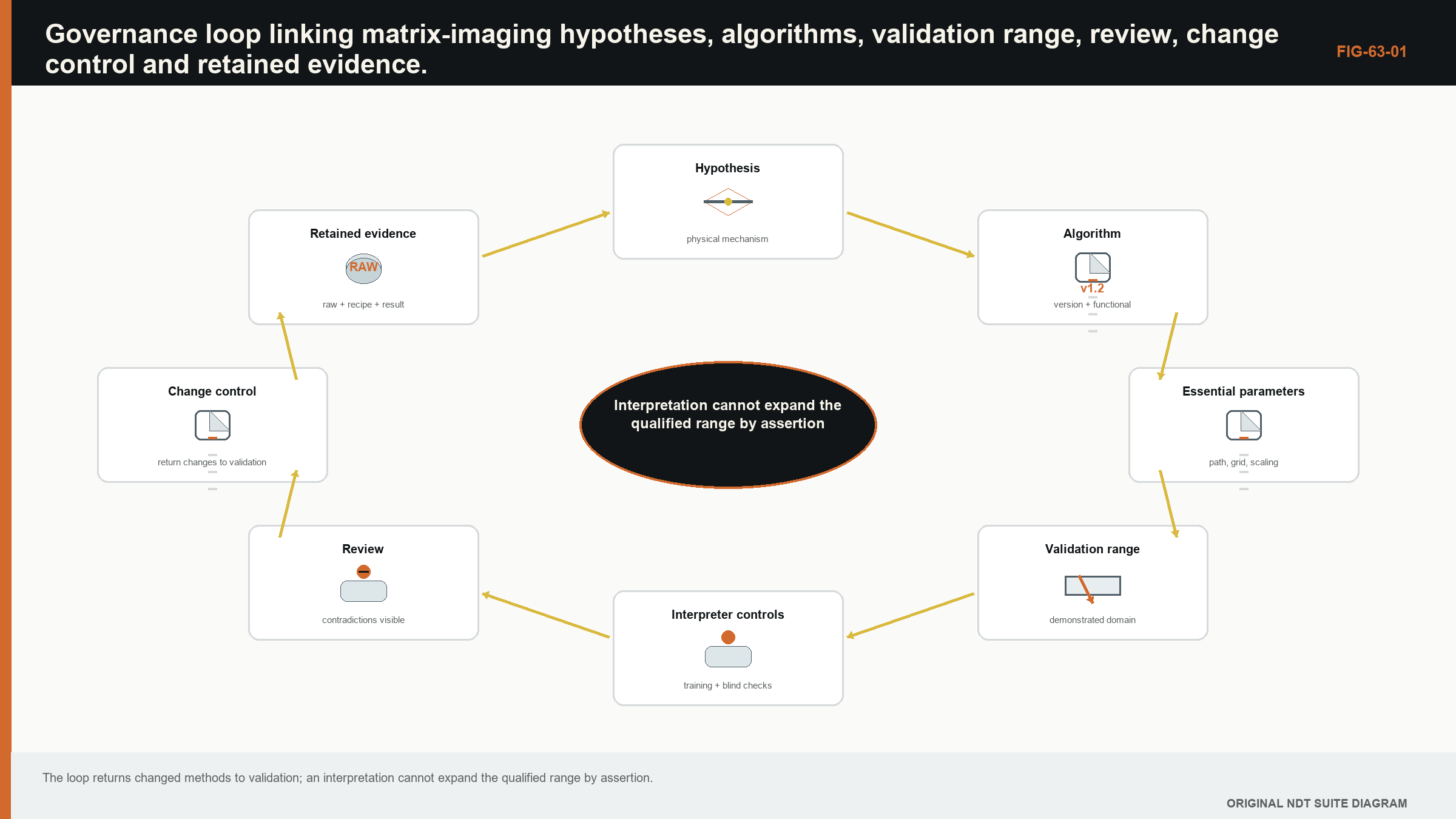
The governing principle is traceability from physical interaction to decision. Advanced processing lengthens that chain and increases the need for explicit models, versions and review. It does not transfer responsibility to the algorithm.
| Worked example · Updating odds without double-counting dependent views WE-63-01 Known: Prior odds for a planar flaw hypothesis versus geometry are 1:4. One validated opposite-side view has likelihood ratio 8 in favour of the flaw. Two additional processed views are derived from the same traces and path and are not treated as independent. Find: Updated odds using the independent evidence only. Method: Prior odds are 0.25. Multiply by likelihood ratio 8: posterior odds = 2.0, equivalent to probability 2/(1+2) = 0.667 under the simplified two-hypothesis model. Result: Updated probability is about 67% in this illustrative model. Engineering meaning: Multiplying additional dependent view ratios would overstate evidence. Real likelihoods require validated populations; qualitative use may be more honest when those data do not exist. |
|---|
Guided Level 3 case: reaching a bounded technical conclusion
A weld dataset contains a response supported by two shear-wave views. A longitudinal view is weak, and a coherence image emphasises a nearby geometry feature. One sizing method reports 5.8 mm while another reports 7.1 mm. The software was updated after the original demonstration. These facts do not combine into one automatic answer; they define the evidence that must be separated and reviewed.
List plausible hypotheses before choosing one. The response may arise from a planar discontinuity, a known geometric boundary, mode-converted energy or a reconstruction artefact. For each hypothesis, record the observations it predicts: position across views, movement with probe or path, phase behaviour, response extent and sensitivity to model changes. This prevents the strongest-looking image from defining the hypothesis after the fact.
Assess dependence. Two views reconstructed from the same matrix and similar paths share acquisition noise, timing and model assumptions. They are not equivalent to two independent tests. Coherence calculated from the same aligned samples is complementary but also dependent. A probability update that treats all three as independent would overstate the evidence.
Review the size estimates as measurements. Identify the response feature used by each method, the grid and interpolation, the velocity and geometry model, and the demonstrated bias on representative references. If their difference exceeds the combined supported uncertainty, report the conflict rather than selecting the preferred number. A redesign or additional evidence may be required.
Compare the current software with the demonstrated version using controlled reference datasets. If the update changed interpolation, contributor rules or coherence calculation, the impact must be tested on target and nuisance cases. Matching one screenshot is not sufficient evidence of comparability.
The technical conclusion then uses bounded language. It states which hypothesis is best supported, which observations remain inconsistent, the supported coordinate or size range, and whether the result is suitable for the intended evaluation step. It identifies any required rescan, alternative view, model correction or software qualification. The record includes raw-data identity, configuration, version, source evidence and independent review. This is stronger than forced certainty because another competent reviewer can reproduce both the result and its limits.
63.90 Technical extension: closing the matrix-imaging evidence loop
63.90.1 Claim decomposition
A final Level 3 review decomposes a broad conclusion into acquisition validity, path validity, indication interpretation, location, size, uncertainty and evaluation basis. Each element cites evidence and can carry a different confidence. This prevents a strong acquisition record from lending false certainty to an unresolved path, or a plausible path from excusing missing data.
The decomposition also supports partial use. A dataset may support detection and approximate location while not supporting height sizing. Reporting that boundary is more useful than forcing one overall pass/fail description of data quality.
63.90.2 Escalation by information value
When evidence conflicts, select the next action by expected information value. An opposite-side view may distinguish target orientation; a re-scan at the same angle may add little. A reference target can test path; destructive truth may be disproportionate. The chosen action should discriminate leading hypotheses.
This approach controls endless imaging. More views are not automatically more knowledge. The question is which observation would change the decision.
63.90.3 Reanalysis boundaries
Reanalysis is appropriate when raw data and metadata remain valid and the change concerns model or processing. Reacquisition is required when missing time range, clipping, coupling or position destroys needed information. Technique redesign is required when the acquisition lacks target sensitivity even though data are internally valid.
These boundaries should be stated before a failure occurs. Otherwise schedule pressure encourages reprocessing to be used as a substitute for information that was never acquired.
63.90.4 Independent technical defence
A technical defence presents the claim, alternatives, raw evidence, model, sensitivity tests, uncertainty and limitation. It should survive questions about why another path, algorithm or target explanation was rejected. Images support the argument but do not replace it.
The reviewer should be able to trace every derived number to coordinates, path and samples. Where proprietary processing prevents that trace, the limitation and compensating validation should be explicit.
63.90.5 Part VII synthesis
Parts VI and VII separate acquisition from reconstruction, and reconstruction from interpretation. Matrix architecture controls identifiability. Functionals define the image quantity. Path models control delay and location. Numerical implementation controls reproducibility. Coherence creates another evidence domain with distinct failure modes. Optimisation chooses trade-offs. Validation and forensics establish boundaries.
The unifying discipline is to preserve raw information, declare every model and version, test competing explanations and report only the performance that evidence supports. [R017] [R018] [R019] [R031] [R032] [R045] [R047] [R048] [R050] [R060] [R061]
63.91 Release-ready Level 3 record
The release record contains a claim matrix, configuration baseline, raw-data hashes, reconstruction recipes, validation references, interpretation evidence, uncertainty and limitations. It identifies who performed independent reviews and what each review covered.
Every final image is reproducible from a raw parent and controlled recipe. Every reported coordinate states frame and path. Every size states method and measurand. Every evaluation cites its governing basis rather than implying that the imaging method supplies acceptance.
Where evidence is conditional, the report preserves conditions. A plausible planar response with unresolved lower tip remains a detection and location result with a sizing limit. This is not incomplete engineering; it is accurate communication.
The Level 3 handover also identifies monitoring signals: reference trends, algorithm regression, false-call feedback and abnormal events. These controls keep qualification connected to operation and define when revalidation is triggered. [R045] [R047] [R048] [R050] [R060] [R061]
63.92 Technical handover boundary
The handover identifies which chapters and appendices contain the controlled coordinate, path and uncertainty conventions; which datasets reproduce the principal cases; and which open questions remain research rather than production capability.
It also states that standards, certification and software labels do not replace application evidence. Future additions must preserve raw-data lineage, source citations, original figure rights and the distinction among acquisition, reconstruction, interpretation and engineering decision. [R045] [R047] [R048] [R050] [R060]
Chapter synthesis
Advanced interpretation is structured inference across dependent and complementary views. Probabilistic reasoning can organise evidence only when likelihoods and dependence are controlled. Sizing requires a defined measurand, path and uncertainty model, with bounds when resolution fails. Fusion preserves conflict until coordinate, model and data-quality causes are tested. Algorithms and versions are part of the measurement and must be reproducibly declared. Independent review challenges raw data, paths and alternative hypotheses. Cases involving geometry coherence, numerical instability, information loss, software change or model conflict may require technique redesign rather than a more flattering display.
Key equations and relationships
| (63.2) Log likelihood ratio for conditionally independent evidence · EQ-63-02 Where: Lambda_k = likelihood ratio for evidence item k; Lambda_total = combined likelihood ratio Model limits: evidence items are conditionally independent under compared hypotheses or dependence is modelled; validated likelihoods exist |
|---|
In plain words
- The chapter's central control is bounded conclusion, and its meaning must be stated before its mathematics or software implementation.
- A faster, sharper or cleaner result is not automatically a more reliable result.
- Every claimed improvement depends on a declared dataset, model, configuration and target population.
- Known reference cases and deliberately difficult cases reveal different weaknesses.
- Stored raw evidence, metadata and software identity make later review possible.
- The technical conclusion must remain inside the boundary demonstrated by the evidence.
Key terms in this chapter
The words introduced at the chapter opening are the minimum vocabulary for its Level 3 work. Use them consistently in the technique, validation record and report. Where a supplier uses a different label, record the supplier term without allowing it to replace the physical definition.
Common mix-ups
- Do not confuse a similar displayed image with equivalent retained information.
- Do not confuse software verification with physical validation of an inspection technique.
- Do not confuse an assumed model output with a directly observed quantity.
- Do not confuse a demonstrated result for one target population with universal capability.
Independent review checkpoint
Give a second competent reviewer the raw or reference data, the declared bounded conclusion method, the controlled configuration and the expected comparison outputs. The reviewer should be able to reproduce the important result without using an undocumented display adjustment or private software setting. Record the version, input identity, contributor or channel mask, model inputs, numerical tolerances and any excluded cases. Also record one observation that would contradict the preferred explanation. Where the result supports a decision, the reviewer records the nearest failure boundary and one realistic change that would trigger revalidation. This checkpoint does not turn independent review into a ceremonial signature. It tests whether the evidence chain is understandable, repeatable and honest about its limits.
Bridge forward
Part VIII begins the formal engineering treatment and derives the models, statistics and computation that these Level 3 controls use.
Sources and further study
- [R017]
- [R018]
- [R019]
- [R031]
- [R032]
- [R033]
- [R034]
- [R045]
- [R047]
- [R048]
- [R050]
- [R060]
- [R061]
Study and revision only. This is not an approved inspection procedure, acceptance criterion or qualification.