
CHAPTER 1 · Ultrasonics Level 3
Level 3 Authority and the Inspection System
In this chapter · 9 sections
Learning outcomes
By the end of this chapter, the learner should be able to distinguish certification, employer authorisation and job authority; describe the typical technical functions of Level 1, Level 2 and Level 3 personnel; frame an ultrasonic examination as a controlled measurement system; separate method selection, technique design, execution, interpretation and acceptance; and identify when a Level 3 decision requires escalation or additional qualification.
1.1 Certification is one control, not the whole authority
Personnel certification indicates demonstrated competence within a stated method, level and industrial sector. Employer authorisation determines what that person may actually do for the organisation. Job documents determine what must be done for a particular component. These controls overlap, but they are not interchangeable.
A Level 3 certificate does not make every unfamiliar application valid. When a technique lies outside demonstrated capability, the responsible person must obtain additional knowledge, specialist support, trials or qualification evidence. Honest technical limits are part of competence.
1.2 Functional boundaries between levels
A Level 1 person normally performs defined tasks to written instructions, records results and classifies them using stated rules under the required supervision. A Level 2 person normally selects an authorised technique within an approved procedure, sets up and verifies equipment, performs or supervises tests, interprets indications, evaluates results against nominated criteria and prepares instructions or reports within scope.
Level 3 responsibility is broader. Typical functions include:
- directing ultrasonic operations and providing technical support;
- interpreting applicable codes, standards and specifications;
- selecting methods and techniques for an inspection objective;
- preparing, reviewing or approving procedures where authorised;
- establishing qualification or demonstration requirements;
- determining equipment and personnel capability needs;
- resolving technical departures and recording their disposition;
- integrating materials, fabrication and service knowledge into the inspection plan;
- supporting training, examination and competence assurance.
The boundary is defined by the applicable certification scheme, employer written practice and regulatory or contractual controls. The list above is a framework, not a substitute for those documents.
1.3 The examination as a measurement system
An ultrasonic result is produced by a system, not by the flaw detector alone. The system includes:
- the inspection objective and governing documents;
- component material, geometry, manufacturing history and service condition;
- probe, wedge, cable, couplant, scanner and instrument;
- calibration and reference standards;
- scan plan, coverage and acquisition controls;
- personnel competence and human factors;
- interpretation, sizing, evaluation and reporting rules;
- records that allow the work to be reconstructed.
An error in any link may weaken the conclusion. High signal amplitude does not repair missing coverage. A valid calibration does not make an unsuitable reflector representative. A polished report cannot make an unqualified technique qualified.
1.4 Five separate decisions
Level 3 work becomes clearer when five decisions are kept separate.
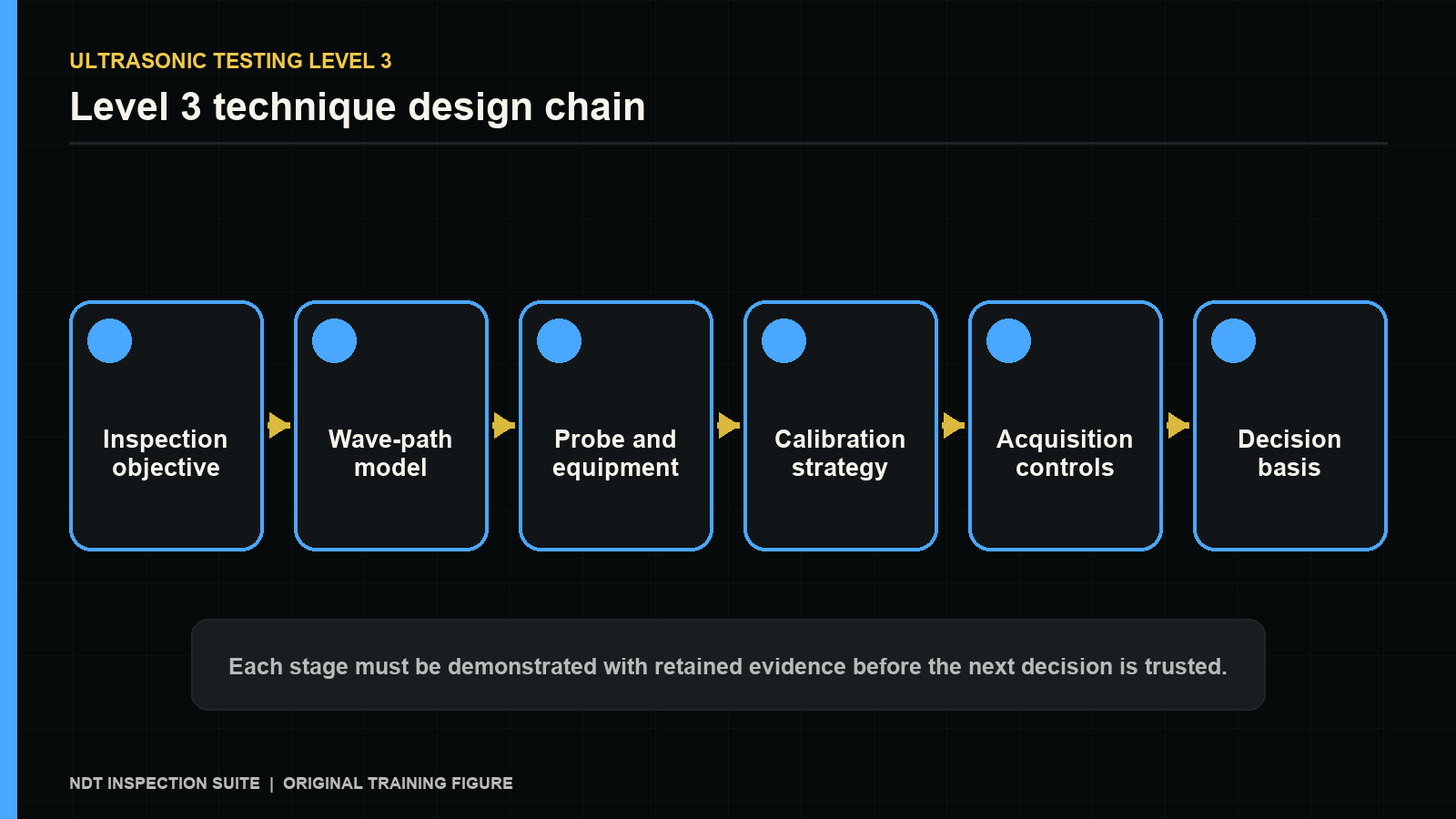
Method selection asks whether ultrasound is suitable for the material, geometry and expected discontinuity. Technique design then determines the wave mode, probe, frequency, scan path and sensitivity controls needed to meet the objective. Execution asks whether that approved technique was applied and monitored correctly. Interpretation identifies the physical feature most likely to have caused each response, while evaluation applies the governing reporting and acceptance rules to the interpreted result.
Keeping these decisions distinct prevents a strong signal from being treated as automatic rejection, or a convenient disposition from influencing the physical interpretation.
Acceptance must not be reverse-engineered from the signals. If the contract does not identify acceptance criteria, the Level 3 obtains clarification; the Level 3 does not quietly invent a convenient threshold.
1.5 Decision gate example
A forged shaft must be examined for fatigue cracking near a diameter transition. Drawings are incomplete and the transition is inaccessible from one end. Before specifying probes, the Level 3 should confirm the actual geometry, access, material condition, expected crack orientation, required detection capability and governing criteria. A trial on a representative mock-up may be necessary. The correct first decision is therefore a readiness decision, not an angle selection.
1.6 Relationship to other NDT methods
A Level 3 needs enough general method knowledge to recognise when ultrasound should be supplemented or replaced. Visual testing establishes accessible surface condition, geometry and workmanship. Penetrant testing responds to surface-breaking openings in suitable non-porous materials. Magnetic particle testing provides sensitive surface and near-surface examination of ferromagnetic materials. Eddy current testing responds to electromagnetic changes in conductive material and can be valuable at surfaces, tubing and through suitable coatings. Radiographic methods map thickness and density variation through a projected image and often respond well to volumetric conditions. Acoustic emission monitors active energy release under load, while thermographic and optical methods address different surface or subsurface contrasts.
The Level 3 method-selection question is not which method appears most advanced. It is which combination can produce the required evidence with the available access, material, geometry, safety controls and decision threshold.
1.7 Safety is an essential variable
Conventional UT does not use ionising radiation, but the work is not hazard-free. Couplant can create slip hazards; cables and scanners create trip, pinch and entanglement hazards; electrical equipment and batteries require inspection and suitable environmental protection; hot components require rated probes, controlled contact time and thermal PPE; tanks introduce water, lifting and motion hazards; and field access may involve confined spaces, work at height or operating plant.
Specialised methods add controls. Laser systems require controlled optical hazards and interlocks. EMAT equipment can involve strong magnetic fields, high currents and restrictions around implants or ferromagnetic objects. Couplants and cleaners require safety-data review, ventilation, compatibility and disposal controls. The inspection plan must follow the site's risk assessment, isolation, permit, PPE and emergency requirements. Acoustic access never justifies bypassing a guard or entering an uncontrolled plant state.
Failure modes and decision control
Weak practice commonly includes treating certification as unrestricted authority; approving a technique without defining the inspection volume; using a familiar method because it is available rather than suitable; merging interpretation and acceptance into one subjective judgement; allowing production pressure to become an undocumented technical requirement; and accepting a vendor preset as a qualified procedure.
Study and revision only. This is not an approved inspection procedure, acceptance criterion or qualification.