
CHAPTER 1 · PT Level 2
PT Purpose, Scope and the Level 2 Role
In this chapter · 9 sections
Learning outcomes
The learner should be able to explain what PT detects, state its advantages and boundaries, distinguish PT from other NDT methods, outline the process sequence and describe Level 2 technical and documentary responsibilities.
1.1 What penetrant testing does
Liquid penetrant testing uses a mobile liquid to enter a discontinuity that is open to the examination surface. After controlled removal of liquid from the surrounding surface, developer promotes bleed-out and creates a visible or fluorescent indication larger and more contrasting than the original opening.
The method developed from early oil-and-powder techniques in which oil entered surface cracks and a pale absorbent coating revealed seepage. Modern visible and fluorescent dyes, engineered removers, controlled developers and measured viewing conditions made the process more sensitive and repeatable. The historical lesson is practical: the underlying sequence remains entry, surface cleaning and amplified bleed-out, while reliable results depend on control of every stage.
PT can reveal cracks, seams, laps, cold shuts, porosity or lack of fusion when the condition reaches an accessible surface. It does not determine the full depth of a discontinuity and cannot detect a sealed internal condition. The test is suited to many non-porous metals, ceramics, glasses and some polymers, provided the exact material and chemicals are compatible.
Porous surfaces retain penetrant and produce excessive background. Coatings, scale, smeared metal and contamination can block openings. Rough texture can trap penetrant. Temperature, dwell, removal, developer and viewing conditions all change performance.
1.2 Advantages and limitations
Advantages include portability, comparatively simple equipment, coverage of complex accessible shapes, usefulness on ferrous and non-ferrous materials and strong sensitivity to fine surface openings. Visible colour-contrast systems can be used without a dark booth; fluorescent systems can provide higher visual sensitivity when viewing conditions are controlled.
Limitations include surface-only detection, demanding cleaning, chemical compatibility concerns, process time, operator dependence and difficulty on porous or very rough surfaces. PT may not distinguish depth, and indication size can grow during development. Environmental, fire, skin, inhalation and UV-A risks require controls.
1.3 PT in the NDT family
VT identifies visible surface conditions. MT can reveal surface and some near-surface conditions but is limited to ferromagnetic material. ET can detect surface and near-surface effects in conductive material and may work through some coatings. UT and RT can examine internal regions. PT remains valuable because it directly amplifies very fine openings with modest equipment, not because it replaces every other method.
1.4 General process sequence
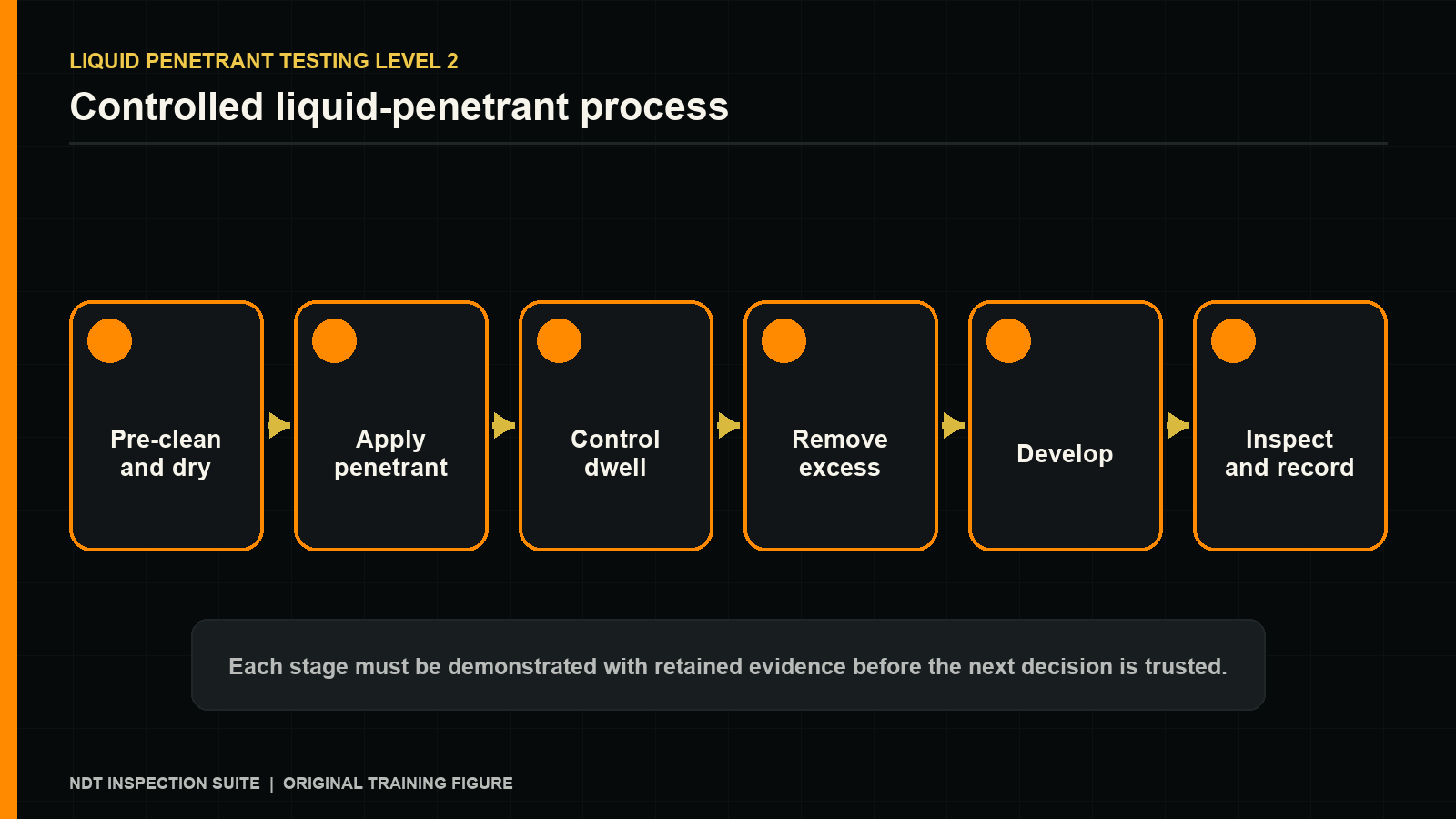
The controlled sequence is:
- Review the instruction, component identity, material, surface, temperature and safety, and confirm that required system and equipment checks are current before production examination begins.
- Pre-clean without damaging or closing discontinuities.
- Dry the surface and discontinuities.
- Apply the approved penetrant completely.
- Maintain the required penetration dwell while preventing drying.
- Remove excess surface penetrant by the designated method.
- Dry when required by the developer route.
- Apply a thin, even developer layer as specified.
- Observe during the required development period under verified viewing conditions.
- Interpret, evaluate, record and report.
- Post-clean and protect the component when required.
- Complete the examination record, any checks due after use, and all required traceability.
Changing the order or mixing product families can invalidate the result.
1.5 Level 2 responsibility
Within certification and employer authorisation, Level 2 personnel may select an authorised technique, translate a procedure into a work instruction, verify equipment and materials, perform and supervise testing, interpret indications, evaluate results against nominated criteria, guide Level 1 personnel and complete reports.
Level 2 personnel must not invent acceptance limits, approve an unqualified product combination, change an essential parameter outside procedure limits or conceal incomplete coverage. Ambiguous requirements go to the Level 3 or designated technical authority.
Practical checkpoint
Inspect a component drawing and mark every surface that is accessible, coated, machined, porous, hot, chemically restricted or safety critical. State which surfaces are suitable for PT and which require another method or technical disposition.
Common errors and misconceptions
Several common errors recur in this topic: believing PT can find a closed internal crack; treating a clean-looking surface as chemically clean and dry; mixing penetrant, remover and developer without product-family approval; calling an indication a defect before evaluation; and reporting full coverage when geometry blocked inspection.
Chapter summary
PT reveals surface-connected openings by entry, controlled removal and bleed-out. It is versatile but highly dependent on surface condition, compatible products and disciplined timing. Level 2 authority includes interpretation and evaluation within controlled documents, not permission to improvise requirements.
Study and revision only. This is not an approved inspection procedure, acceptance criterion or qualification.