
CHAPTER 6 · Materials All levels
Alloying and Ferrous Materials
In this chapter · 7 sections
Learning outcomes
The learner should be able to classify common steels and cast irons, explain principal alloying effects without overgeneralising, distinguish stainless families, use carbon-equivalent concepts cautiously and relate ferrous product structure to NDT.
6.1 Carbon and alloy steels
Carbon increases the strength and potential hardness of steel but generally reduces weldability and easy ductility as content rises. Low-carbon steels are widely formed and welded. Medium-carbon grades can be strengthened by heat treatment. High-carbon grades serve springs, tools and wear applications when suitably processed. Boundaries between these groups vary among specifications, so the product standard controls the grade description.
Manganese supports deoxidation and strength and combines with sulphur. Silicon is also a deoxidiser and can strengthen ferrite. Chromium supports hardenability, wear and oxidation or corrosion resistance. Nickel can improve toughness and corrosion resistance. Molybdenum supports high-temperature strength and hardenability. Vanadium, niobium and titanium can refine grains or form strengthening carbides and nitrides. The result depends on amount, interactions and heat treatment; an alloying element does not deliver one property by itself.
Hardenability is the ability to form hard structure through a section during a specified cooling condition. It is different from maximum hardness. An alloy steel may achieve a deep hardened zone even when its peak hardness is limited by carbon content.
Carbon-equivalent formulas provide screening for weldability and hydrogen-cracking risk. One widely used form is:
CE_IIW = C + Mn/6 + (Cr + Mo + V)/5 + (Ni + Cu)/15
All values are mass percent. The formula and limits must be those nominated by the welding or construction document; it is not a stand-alone permission to weld.
6.2 Stainless steel families
Stainless steels rely on sufficient chromium to form a protective passive film. Austenitic grades are generally non-ferromagnetic in solution-treated condition, though cold work or weld ferrite can produce magnetic response. They offer good corrosion resistance and toughness but may suffer chloride stress-corrosion cracking, sensitisation or hot cracking under relevant conditions.
Ferritic stainless steels are chromium-rich BCC alloys and are ferromagnetic. Martensitic stainless steels can be hardened by heat treatment and are also ferromagnetic. Duplex stainless steels contain ferritic and austenitic phases; phase balance, heat input and service environment matter. Precipitation-hardening stainless grades use ageing treatments for high strength.
"Stainless" does not mean immune to corrosion. Surface contamination, crevices, chlorides, temperature and incorrect fabrication can defeat passivity.
6.3 Cast irons
Cast irons contain enough carbon and silicon for their solidification and graphite form to dominate behaviour. Grey iron contains graphite flakes and has good damping and machinability but low tensile ductility. Ductile iron uses spheroidal graphite to improve toughness and strength. White iron retains much carbon as carbide and is hard and wear resistant but brittle. Malleable iron is produced by prolonged heat treatment of suitable white iron. Compacted graphite iron has intermediate graphite shape and property balance.
Graphite and coarse structure scatter ultrasound and influence magnetic response. Cast surface roughness affects PT, MT and UT coupling. The grade and section should be confirmed before assuming a method demonstrated on wrought steel will transfer.
6.4 NDT field workflow
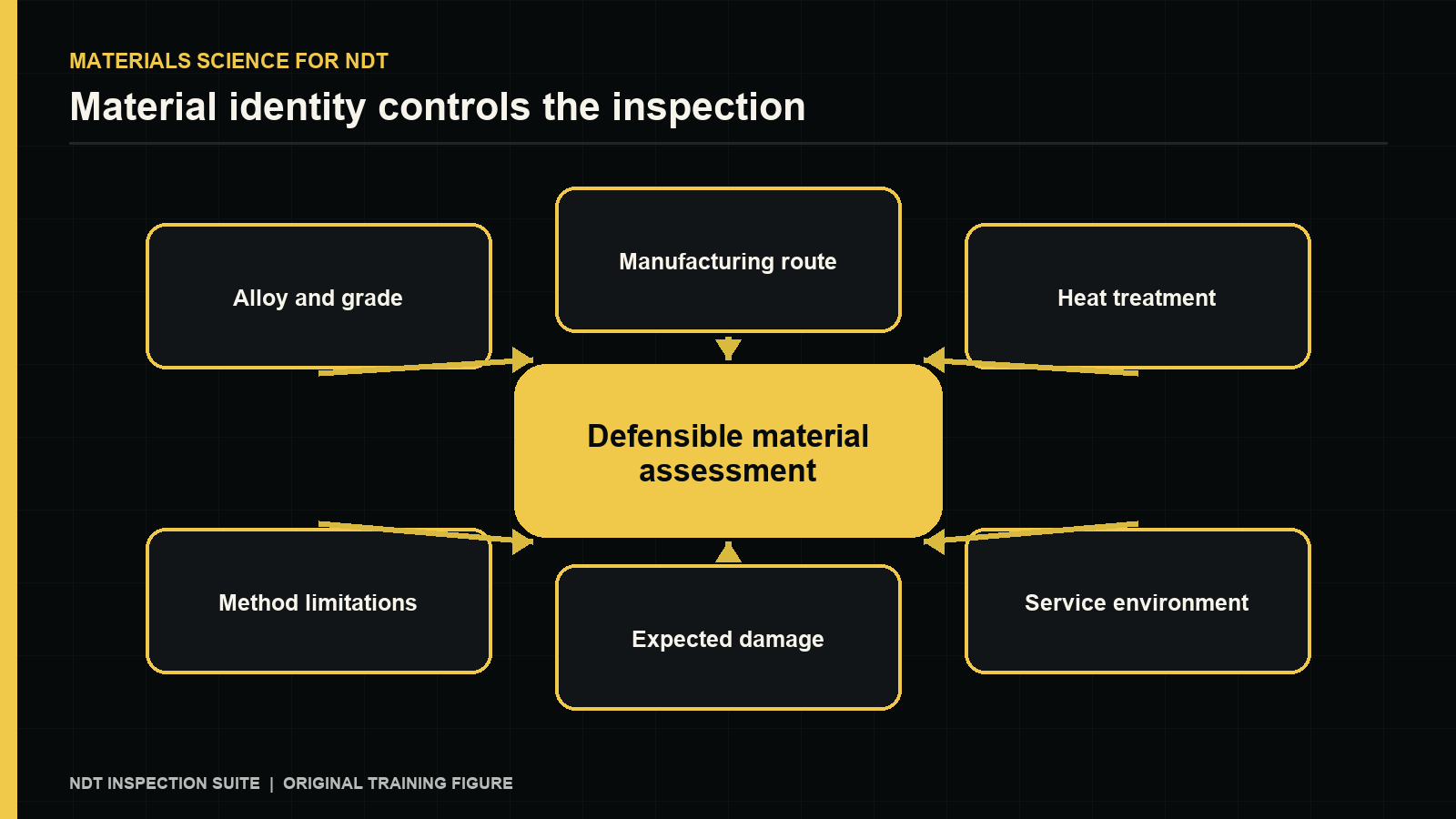
Confirm material specification, product form and heat-treatment condition. Check whether the expected phase is ferromagnetic, whether coarse structure limits UT, whether surface chemistry restricts penetrant products, and whether welding altered local phase or grain structure. Use a representative reference piece where required.
Common errors and misconceptions
Several common errors recur in this topic: confusing hardenability with hardness; assuming austenitic stainless is always completely non-magnetic; treating all cast iron as grey iron; using a carbon-equivalent result outside its governing procedure; and calling corrosion-resistant steel corrosion-proof.
Chapter summary
Ferrous properties emerge from composition, phase, graphite form and thermal history. Carbon and alloy additions influence strength, hardenability, toughness, weldability and corrosion behaviour. Stainless and cast-iron families require different NDT assumptions from plain wrought steel.
Study and revision only. This is not an approved inspection procedure, acceptance criterion or qualification.