
CHAPTER 14 · PT Level 2
Safety, Procedure Control, Supervision and Troubleshooting
In this chapter · 12 sections
Learning outcomes
The learner should be able to control chemical, fire, UV-A, electrical and environmental hazards, build a Level 2 work instruction, supervise PT performance, diagnose common failures and apply clear stop-work rules.
14.1 Chemical and fire safety
Review the current safety data sheet for every cleaner, penetrant, remover and developer. Identify flammability, exposure routes, ventilation, incompatible materials, storage, first aid, spill response and disposal. Aerosol propellant and solvent vapour can travel to ignition sources. Enclosed spaces require specific ventilation and entry controls.
Wear the PPE determined by risk assessment, commonly chemical-resistant gloves and eye protection. Avoid skin contact and never use penetrant cleaner for personal cleaning. Decant only into labelled compatible containers. Control static, hot surfaces and open flames. Dispose of contaminated cloth as a potential fire and chemical hazard.
14.2 UV-A and electrical safety
Use approved UV-A equipment with intact filters, guards, leads and housings. Do not stare into the beam. Limit unnecessary skin and eye exposure and follow manufacturer requirements. Damaged mercury lamps require hazardous-material response. Electrical equipment in wet rinse areas needs suitable protection, inspection and test status.
UV-A is lower energy than UV-B or UV-C but "lower risk" does not mean risk free. Photosensitising chemicals or medicines may increase sensitivity. Report symptoms and follow occupational-health requirements.
14.3 Environmental control
Prevent penetrant chemicals and contaminated water entering uncontrolled drains. Fixed systems may require separation, treatment and licensed disposal. Field work needs spill containment and waste return. Product selection, spray control and reusable systems can reduce waste without weakening the qualified process.
14.4 From procedure to work instruction
A Level 2 work instruction should identify component and area, material, surface and temperature; product family; cleaning and drying; application and dwell; removal variables; developer and development; viewing limits; evaluation source; system checks; safety; post-cleaning; records; and stop points. It should be usable by the intended Level 1 technician without requiring hidden assumptions.
Supervision includes observing technique, checking records and preventing shortcuts. Competence is demonstrated by repeatable results and correct decisions, not by speed alone.
14.5 Troubleshooting map
High background: inadequate pre-cleaning, rough surface, under-removal, wrong emulsifier time or concentration, contaminated rinse, thick developer, dirty booth.
Weak or missing known indications: over-removal, short dwell, dried penetrant, wrong product family, low UV-A/white light, excessive ambient light, thick developer, contaminated or degraded penetrant, closed openings.
Diffuse indications: excessive development, thick developer, rough surface, contamination or broad shallow conditions.
Streaks and fibres: dirty cloth, direct remover spray, brush hairs, run-off or poor wiping.
Unstable fluorescent brightness: lamp warm-up, battery, distance, meter error, dye fade, contamination or changing dark adaptation.
Troubleshoot one controlled variable at a time where practical. Repeat the system check after correction and assess previously tested components.
14.6 Stop-work rules
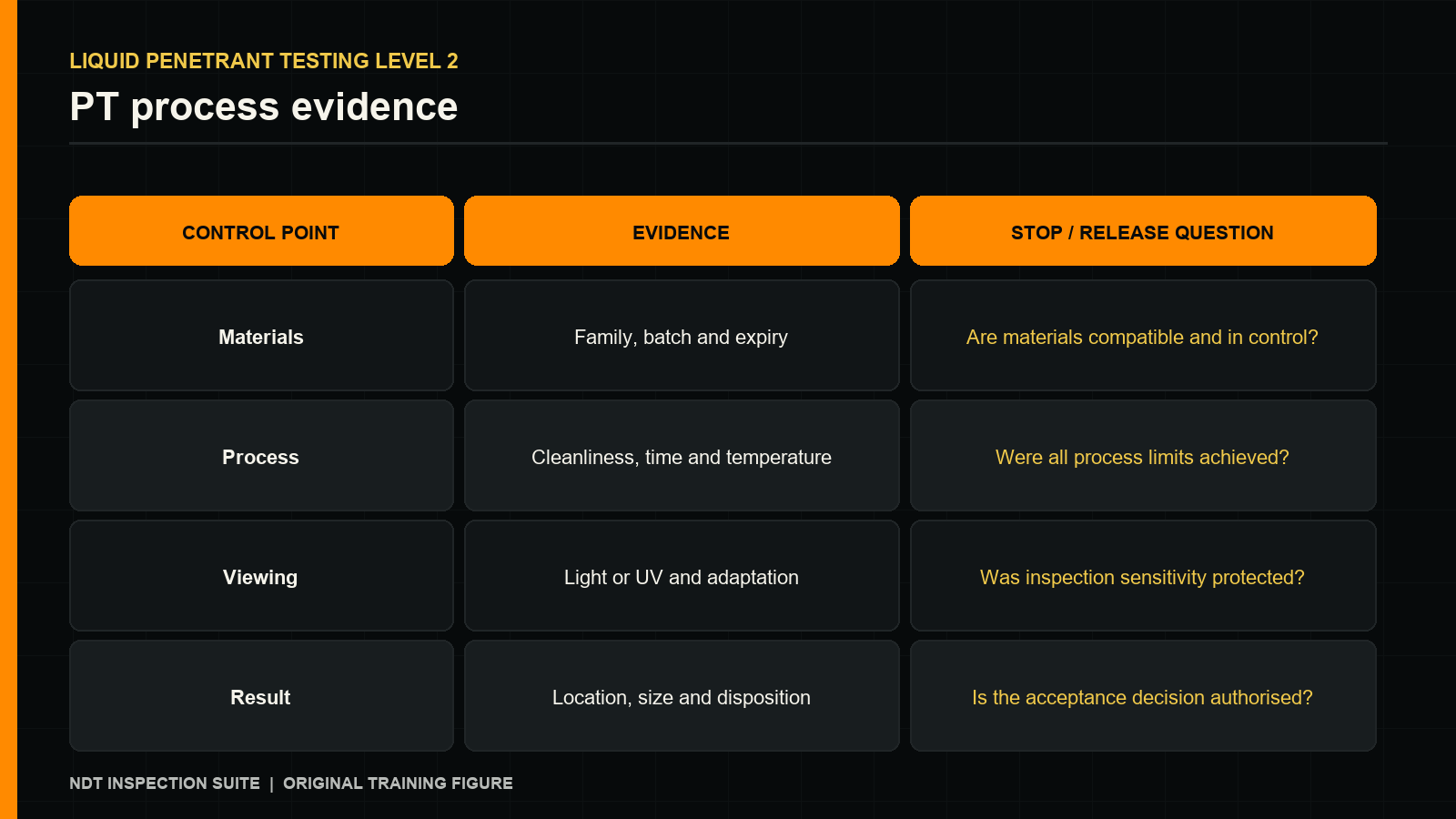
Stop when the wrong or untraceable product is present, process time is missed, temperature is out of range, viewing fails, the reference check fails, chemical exposure control is inadequate, the surface is unsuitable, acceptance is missing or the result exceeds authorisation. Record the stop and protect the component.
Practical checkpoint
Lead a supervised PT exercise with one learner performing the work and another auditing against the instruction. Introduce two safe simulated faults, such as an expired calibration label and low light reading. The performer must stop, diagnose and document corrective action.
Common errors and misconceptions
Several common errors recur in this topic: reading the product label but not the SDS; treating gloves as permission to ignore contamination; bypassing a failed system check to keep production moving; writing a work instruction that says only "per procedure"; and changing several variables at once during troubleshooting.
Chapter summary
PT uses chemicals, light sources and sometimes wet electrical environments. Safety and environmental controls are inseparable from technique. Level 2 personnel convert approved requirements into executable instructions, supervise the process and stop when validity or safety fails.
Compact field glossary
Background: Residual colour or fluorescence on the general surface after removal. Bleed-out: Penetrant emerging from a discontinuity into developer. Development time: Controlled interval in which developer forms indications. Discontinuity: Interruption in normal material or geometry; not automatically rejectable. Emulsifier/remover: Product that makes post-emulsifiable surface penetrant water removable. False indication: Evidence caused by contamination or incorrect processing. Fluorescence: Emission of visible light after absorption of suitable radiation. Indication: PT evidence requiring interpretation. Penetration dwell: Controlled time for penetrant entry. Product family: Qualified combination of penetrant, remover/emulsifier and developer. Relevant indication: Evidence caused by a discontinuity requiring evaluation. Sensitivity: Demonstrated ability of the complete process to reveal specified reference conditions. UV-A irradiance: UV-A radiant power incident per unit area. White-light illuminance: Visible light incident per unit area, measured in lux.
Controlled references to verify before approval
Before formal approval, establish a current reference register for qualification and certification; penetrant general principles; penetrant-material testing; reference blocks; viewing conditions; NDT terminology; applicable product or construction codes; occupational safety law; waste and environmental requirements; and manufacturer technical and safety data. Edition years are intentionally omitted until confirmed through document control.
Study and revision only. This is not an approved inspection procedure, acceptance criterion or qualification.