
CHAPTER 5 · PT Level 2
Penetrant Application and Penetration Dwell
In this chapter · 8 sections
Learning outcomes
The learner should be able to compare application methods, achieve complete coverage, control penetration dwell, adjust only through authorised provisions, prevent drying and recognise conditions that invalidate the penetrant stage.
5.1 Application methods
Penetrant may be brushed, sprayed, flowed, poured, dipped, immersed or applied electrostatically when the product and facility support it. The method must wet the entire examination area without contamination or excessive waste. Brushing is controlled for local areas but a dirty brush introduces fibres and foreign material. Aerosol spraying is portable but needs ventilation, overspray and ignition control. Immersion supports production throughput but creates bath-contamination risk.
Application direction should not leave shadowed regions around threads, keyways, weld profiles or complex geometry. Pools can drain into adjacent areas and later create excessive background. A thin continuous wet film is usually sufficient; more penetrant does not compensate for poor cleaning.
5.2 Penetration dwell
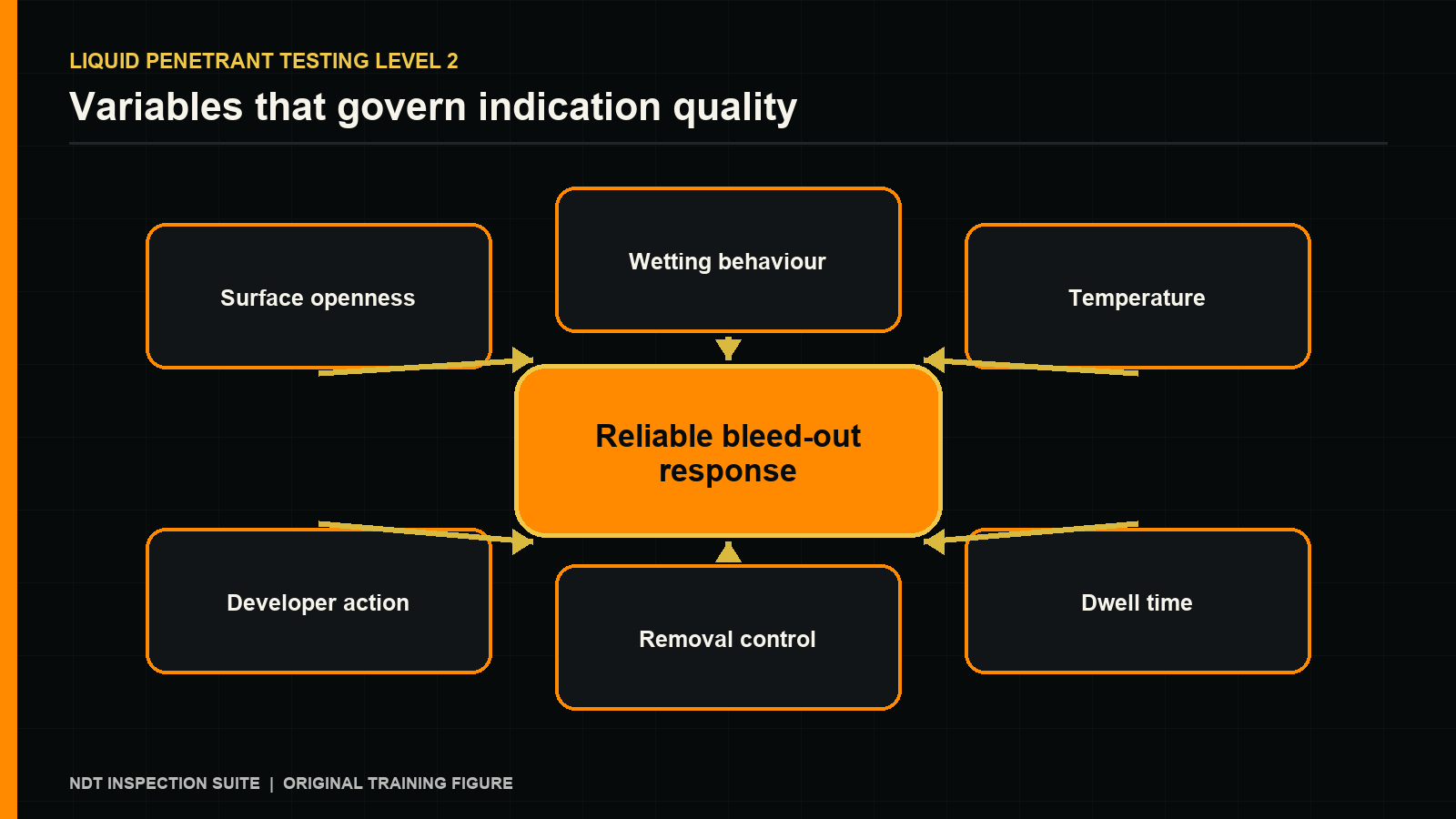
Penetration dwell is the time allowed after application for penetrant to enter surface openings. It begins and ends as defined by the approved procedure, which should account for complete application. Dwell selection depends on material, manufacturing process, suspected discontinuity, temperature, product system and governing requirement.
Fine tight cracks, cold surfaces or viscous products can require longer dwell than broad open porosity. Excessively long dwell may permit drying, contamination or difficult removal. The surface must remain adequately wetted; authorised reapplication can maintain the film but does not restart or extend time unless the instruction says so.
5.3 Orientation and drainage
Capillary action can work against gravity, but orientation affects drainage, coverage and retained surface film. On vertical or overhead surfaces, repeated controlled application may be needed. Thixotropic or special products can be specified for difficult geometry. A field technician must control run-off so that the lower surface does not receive a very different process from the upper area.
5.4 Process invalidation
Reclean and restart when penetrant was applied before complete drying, the wrong product was used, the film dried, dwell was not controlled, contamination occurred, temperature left the qualified range, or an area was missed. Do not repair an invalid penetration stage by increasing developer.
Practical checkpoint
Apply an approved visible system to flat, vertical and overhead training coupons. Use a timer and coverage map. Record start and finish definitions, reapplication, drainage and missed-area controls. Compare background after identical removal. This is a technique exercise, not a qualification of special-position testing.
Common errors and misconceptions
Several common errors recur in this topic: starting dwell timing before the whole area is covered; flooding a surface to make up for weak preparation; letting overspray contaminate a cleaned adjacent zone; assuming gravity has no practical influence because capillary force exists; and extending dwell outside procedure rules.
Chapter summary
Application must produce full, controlled wetting with an approved product. Penetration dwell is a defined process variable influenced by opening, material, product and temperature. Drying, missed coverage or uncontrolled time invalidates the stage and requires proper restart.
Study and revision only. This is not an approved inspection procedure, acceptance criterion or qualification.